
Key Takeaways
- Understanding and selecting optimal mixing techniques drive product consistency and operational effectiveness.
- Equipment selection fundamentally shapes process outcomes in industrial mixing.
- Continuous process improvement enables better quality, efficiency, and cost control.
Table of Contents
- Importance of Mixing in Industrial Processes
- Common Mixing Techniques
- Factors Affecting Mixing Efficiency
- Strategies for Optimizing Mixing Processes
- Case Studies in Effective Mixing
- Conclusion
Uniformity in industrial mixing is a driving force behind product quality and operational efficiency. Industries from food processing to pharmaceuticals rely on advanced mixing techniques to ensure product consistency and optimize workflows. The right approach to mixing can elevate outcomes and cut operational costs, making it a focal point in process engineering. When considering equipment options, the ribbon mixer remains a popular and valuable choice for many businesses where batch consistency is critical.
Adopting the appropriate technique or equipment directly impacts yield, reduces waste, and guarantees adherence to industry standards. Improving mixing operations is not only about technology but also process control, precise equipment matching, and continual assessment. As industries focus more on innovation and efficiency, understanding the nuances of mixing techniques has never been more essential for competitive performance.
Importance of Mixing in Industrial Processes
Mixing is foundational across industrial sectors, including pharmaceuticals, chemicals, and food manufacturing. It enables uniform distribution of raw materials, supporting the production of products that meet quality standards and customer specifications. Uniform mixing helps industries maintain regulatory compliance, reduces batch variability, and supports cost-effective production cycles.
Efficient mixing is also closely tied to sustainability. By achieving homogeneity with fewer resources and shorter processing times, companies can minimize energy consumption and material waste. Ultimately, advanced mixing translates to improved profitability and environmental responsibility.
Common Mixing Techniques
Industries employ a variety of mixing methods tailored to the nature of materials and desired results:
- Blending Miscible Liquids: This technique involves combining liquids that naturally dissolve into one another, yielding a homogenous final mixture. It’s common in beverage production, chemical processing, and other applications that require seamless liquid blending.
- Solid-Liquid Mixing: Dissolving solids in liquid media can be challenging, often requiring specific agitation levels or mixer designs. Industries use impeller or paddle mixers to disperse powders, salts, or fine particles into solvents or reactants.
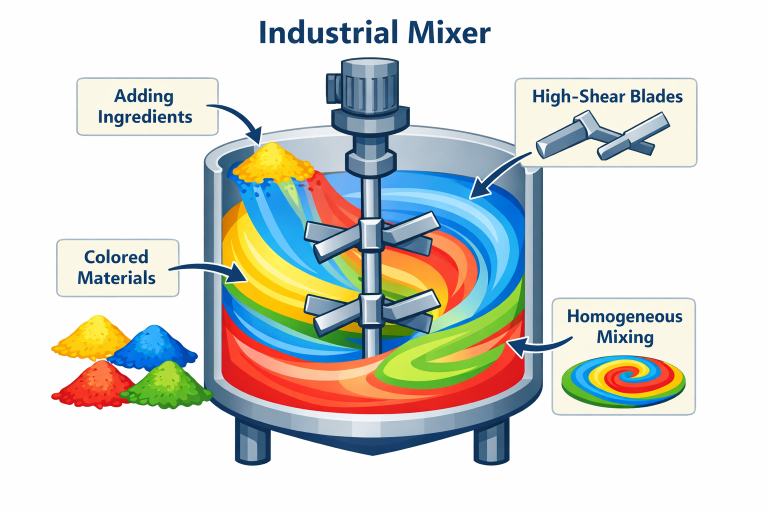
- High-Shear Mixing: Leveraging high-speed blades, this method disperses immiscible liquids or integrates solids into liquids. High-shear mixers are ideal for forming emulsions, fine dispersions, and stable suspensions in industries such as cosmetics and pharmaceuticals.
- Static Mixing: Using stationary internal elements, static mixers blend fluids as they pass through piping, making them exceptionally suited for continuous-flow operations and inline blending.
Factors Affecting Mixing Efficiency
A range of variables can influence how well materials mix. These include:
- Material Properties: Viscosity, particle size, density, and the emulsifying characteristics of input materials can affect the ease and thoroughness of mixing. For example, highly viscous or dense materials often require specialized equipment or increased power input.
- Mixer Design: The form, orientation, and mechanism of the mixer play a vital role in process efficiency. Choosing an inappropriate mixer can lead to subpar mixing, increased processing time, or wasted materials.
- Process Parameters: Factors such as agitation speed, mixing duration, temperature, and fill level must be adjusted and monitored for optimal results. Subtle changes in these parameters can yield significantly different outcomes.
Industrial standards and advancements in process monitoring, such as those outlined in Mixing in the Process Industries, have helped the industry establish benchmarks for mixing efficiency and quality.
Strategies for Optimizing Mixing Processes
Maximizing the performance of mixing processes requires deliberate, data-driven strategies:
- Select the Appropriate Mixer: Align the mixer type and configuration with both the materials and process goals. For example, ribbon mixers excel with powders and pastes, while high-shear mixers are better suited for emulsions and suspensions.
- Optimize Agitation Speed: The right balance between mixing speed and energy usage is vital. Fine-tuning this parameter can enhance product consistency while managing operational costs.
- Implement Process Monitoring: Install sensors and control systems to enable real-time adjustment and deeper insight into process variables. This proactive approach helps prevent variance and reduces the risk of product failure.
- Regular Maintenance: Keeping equipment in peak condition is essential to avoid downtime and extend machine lifespan. Scheduled inspections and maintenance routines are key to ongoing operational success.
Case Studies in Effective Mixing
Real-world applications shed light on the transformative power of optimized mixing strategies:
- Food Processing: By upgrading to high-shear mixing equipment, a food manufacturer improved batch consistency and reduced production cycle time. This change led to improved texture and flavor uniformity in packaged products, all while cutting batch times by nearly half.
- Pharmaceutical Applications: Introducing static-mixing systems into continuous pharmaceutical processing helped a producer achieve uniform drug dispersion. This resulted not only in higher product efficacy but also in increased batch throughput and a measurable decrease in material waste.
An additional example comes from the chemical industry, where companies leveraging robust quality assessments and digital control have markedly improved reproducibility and scalability in large-scale mixing facilities.
Conclusion
Refined mixing techniques and the ability to choose and maintain the right equipment directly affect product quality, operational efficiency, and sustainability in industrial settings. Companies that prioritize ongoing optimization, leverage modern tools, and stay informed about industry advancements are better positioned for long-term success in a competitive global market.

